Posts

Uses and Gratification

Uses and gratification theory looks at why and how people seek out specific media/texts to satisfy specific needs. Uses and gratification is an audience-centered approach to understand what the audience wants in a certain piece of media and how to communicate with them through that piece. As for horror, we must look at what the audience want in horror films and why they watch it. This does connect with my " Why do people watch horror films " post seeing as we do look at the reasons behind it.  Dr. Goldstein: Goldstein suggests that people watch horror films because they want to be frightened, because otherwise they wouldn't keep going to them. People choose to watch these films because they want it to affect them, and in order to feel satisfied at the end there must be a resolution. Audiences can control how much or how little something will affect them, therefore some people may not be affected at all. Dr. Walters: There are many factors that make people want t...
Story and Narrative

Image
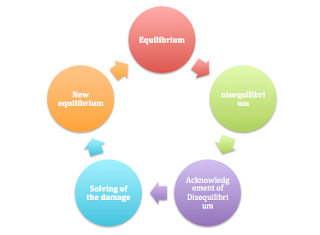
Story and narrative are surprisingly two different aspects of storymaking, whether it's in a book or through the media. One thing that we can establish, is that they are both important and are used to create an effect on the audience that is long lasting.  The story is the events that occur within the film or text. It will give the audience information about the setting, characters and what is happening in the film. The story is usually built up over time to captivate the audience into the film in the way the director/writer intended it to be. Whereas, the narrative is how the story is told. This is mainly looking at the structure of the story, the themes and how it is presented. There is a basic structure to how a story is narrated and this includes a beginning, middle and end, but there are other ways in which a story can be narrated. Todorov's narrative theory: Tzvetan Todorov has proposed a theory in which he looks at the conventional structure of the narrative...

Textual analysis: Unknown number

Image
Unknown number (June 2016)   Unknown number, directed by David Nguyen, is a short that I have looked at in my own time. It involves a young woman in her home reading at late hours, however, this is disturbed when she starts receiving calls from an "unknown number" and so she ignores the number every time it rings. After a while she decides to switch her phone off, yet it still rings regardless of its situation and she answers it, all to receive no answer and then a voicemail after the phone has cut off.   After then, the phone rings again but from a different room and the woman walks to the room, opens the door and finds nothing. At this point, the antagonist, who resembles a dead girl, is behind the woman and then it cuts to her being directly behind the protagonist, who screams once she sees the dead girl and then the short ends. Like Lights out, this film has a similar MES in terms of location. It is set in the home of the protagonist, rather than the convent...

Textual analysis: Lights out

Image
Lights out (2013) Lights out is a Swedish short film, directed by David F. Sandberg that has become a feature length film because of how successful it was. It takes place in the home of a woman who is about to go to bed. However, her usual sleep routine has been disrupted due to the fact that as she switches the lights off, the woman sees a silhouette of another woman. Out of fear, the woman tapes the light switch and heads to bed, leaving the door slightly open. However, she then hears creaking and the hallway light turns off and rampant footsteps, hiding under the blanket. She then peeks out to find the bedroom door wide open, and the desk lamp plugged incorrectly, flickering. She then plugs it back, with everything reverting. She then sees the creature, who turns off the lamp, ending the film. What made this short really effective is the lack of dialogue, the use of sound and the camerawork. The MES of the film is effective in which it is set in a natural setting, the h...

History of horror

Image
Better grab that popcorn and your history books, because we're about to go deep into the history of horror. Looking at what made the horrifying horrible and where we have evolved in terms of the dark and the dangerous. The cinema is MADE for horror, dark and quiet atmosphere, enough to make the film feel real. Enough to make the audience to jump out of their own seats whenever the main antagonist appears to attack their next victim. The cinema is another way for us to escape reality and enter a realm of collective dreams, however, these dreams are nightmares , where the evil and supernatural can roam free with no bounds. The only thing that keeps us safe from them is the screen that separates us.  The roots of filmed horror were an extension of a genre of literature that started in the late 1700s known as Gothic Horror. Developed by writers in Great Britain and the US, the Gothic part of the name refers to pseudo medieval buildings that these stories took place such as an old...

Preliminary Film

Image
This is my preliminary film, in which we had to make a guerilla style horror short. We didn't have much planning for the film seeing as we were to see what our abilities were when making a short. For example, what camera shots we can use for effect, what we can do to build tension and our abilities in terms of editing.  Gif.1 We had to work in a group for the prelim, but within that group we edited  our films separately and this is what I have made from what we have filmed. We all filmed different sections and directed at different points, seeing as we were in a 3, we also had to swap roles each time we progressed with the story. I filmed the scene where the protagonist finds the dead body on the floor (Gif.1), I used a pan as a way to gradually expose the body of the girl from the audience's perspective, as if they were looking at the scene themselves. Gif.2 We have used various shots and angles for our short, for example, mid shots have been used throughout th...

Why do people love horror films: from the psychological perspective