Posts

Evaluation 4:How did you use media technologies in the construction and research, planning and evaluation stages?

Image

Evaluation 3: What have you learned from your audience feedback?

Image
In regards to my feedback, I have made a survey for my film and my poster and shared it through social media, as audience feedback is very important in order for me to look back on my work. I have sent my survey onto social media where I am more likely to get viewers who have never seen the film or the progress towards it and viewers within my target audience seeing as most people who use social media for a majority of the time are teenagers and young adults. I have managed to get some results, but this was from a small sample due to the fact that many people may have not had enough time to watch the short film and do the survey, or due to the fact that most people find survey's to be irritating and a waste of time.  Below are the questions and results of the questions I have asked to my audience.I felt that it was important to ask questions that looked at the audience's interpretation of the film and their general opinion, so that I am able to see whether my film satisfied...

Evaluation 2: How effective is the combination of your main product and ancillary texts?

Image
The main focus for my film was the gap under the bed because not only is it the title; it is also where the main antagonist is located and filmed from. It is an out-of-place area within a normal environment such as home, I have used this to make sure that the audience can feel paranoid when looking at the gap because of how something so simple can still be terrifying when looking at it from a different perspective. I've made sure that my ancillary tasks followed that focus in order for my audience to be able to connect them to my film. My film poster definitely follows this, seeing as the main image is of the gap itself. The colours used are quite dull and dark to follow the colour scheme of the film seeing as the film has a dull filter over it.  The gap has been enhanced so that it is the main focus of the page as it is more dark than the surrounding area. It gives the poster a more eerie sense seeing as no one knows what's in the gap.  In terms of composition of the ima...

Evaluation 1: In what way does your media product use, develop or challenge forms and conventions of real media texts?

Double page spread

Image
For my double page spread, I have decided to follow the "on location" format of Empire magazine. But I have changed it in small ways. I have made sure that the colour scheme follows the Empire colour scheme but it uses colours that are used in horror as well, seeing as the film is in that genre.  The main image takes up one page to show the importance of the girl as the protagonist of the film and it includes a small map with the location and the name of the film under it, which has been used on the Empire on location magazine. On the image is the beginning of the article in the form of 3 columns and this will continue on the other page with 3 more columns. The article explains how the idea for the film formed and what made the director choose her location; however, it is worded as if it were an interview with quotes from the director and it is in 3rd person narrative as if the reporter was talking to their audience. The second page also includes a pull quote stating t...

My film: Gap

Image
Gap

Final film poster design

Image
This is my final film poster design, I used Photoshop and Pixlr to design and edit it and I took my own picture for it. This is the original photo for it and as you can see, I've edited the video in order for it to look more horror based. I faded the image from below the gap into black just like the mirrors poster I looked at before and I have darkened the image to make it more sinister. In terms of composition of the image, I made sure that the positions of the bear was towards the centre of the bed and I used a teddy bear to show that this film will be based within a child's room.  Looking at the poster, the area around the gap is enhanced because the film is heavily based around the gap under the bed, and it would make sense to show it on the poster. However, it doesn't reveal much of the plot, so suspense can be created from the poster. I have picked a dark colour scheme to follow the conventions of the horror poster and made sure that the title was larg...

Film double page spread analysis

Image
In order for me to know what to put on my DPS, I have looked at various film articles from different magazines and out of the ones I have looked at, I picked two. Both from Empire, but are very different from each other. Django Unchained: What I like about the structure of this article is how it states that it is on location and the date of when they filmed it. The images used vary between stills from the film and stills from the production. There are more images than text but this could be done to show the audience what to expect. Rather for them to read what will happen, they can see what will happen through the stills. What I will take from this DPS is the use of mixed stills. One from the actual film and one from the production. It would enable the audience to see what is going on "behind the scenes" without telling them too much information. Just to make them anticipated for the upcoming film. Clash of the titans: Another DPS from Empire in which this time the...

Film poster analysis

Storyboard and screenplay

Image
As part of the planning stage, I made a screenplay and storyboard as a way to combine my final ideas. I looked at examples of  film storyboards and screenplays to get an initial idea of how to make one similar to the one's used. Here they are below: Storyboard: This is my storyboard, it contains rough sketches of what each scene of my short will look like. I have also included small descriptions of what sound will be included, the camera angle and what occurs in the scene. And in some of the panels, I have included an arrow which shows what action the camera would do in that scene and which direction it will be, such as pan towards the door or zoom in. Screenplay: This is my screenplay. As you can see, it is in a similar format to an actual screenplay, but because this is only a short film, the screenplay will only have a few pages. I have used the same font and size for it and I have made sure that I included when the scene cuts, when a character speaks and a descri...

A small synopsis

Image
Transcript: After many hours of research and planning. I've finally managed to come up with a final idea. Here is a quick synopsis of my film: Girl plays with toys. Mysterious unknown being watches the girl play Girl checks it out But! It runs away into hiding And girl goes back to play [ Not with a balloon ] THE LIGHT BULB MOVES!!! AND THERE'S NOISES GIRL GETS SUSPICIOUS [ So she goes and checks again ] THEN SHE CHASES THE BEING whilst it's still under the bed And then, It hides back into the gap under the bed and the girl waits for it. It then reappears and the girl wants to play with it. It does so and then it goes away for the final time. It comes back, but it escapes and the girl confronts it as it hides on her bed. The being goes towards her and the scene cuts to black. The last scene consists of the light swinging and a zoom in of the gap. THE END 

Effects of horror films

Like all forms of media, horror films do influence the audience, whether that's good or bad depends on one's mental state and their personality. There are 6 main effects of horror films, and they are followed: Imitation : Many films, including horror, has been known to take significant effect on society. Films have been known to ferment actions such as general violence, murder and even hate towards a certain group, and this idea is backed up by the cases of "copycats", people who are inspired by a film character and act regarding that character. In 1999, two high students murdered twelve other students and one teacher at Columbine High School in Columbine, Colorado. The massacre ended with both perpetrators committing suicide. It has been confirmed that both students were fans of Natural Born Killers. Prior to the massacre, they had used the initials 'NBK' as their code and made many references to the film. Catharsis: Catharsis is "the p...

Preliminary poster

Image
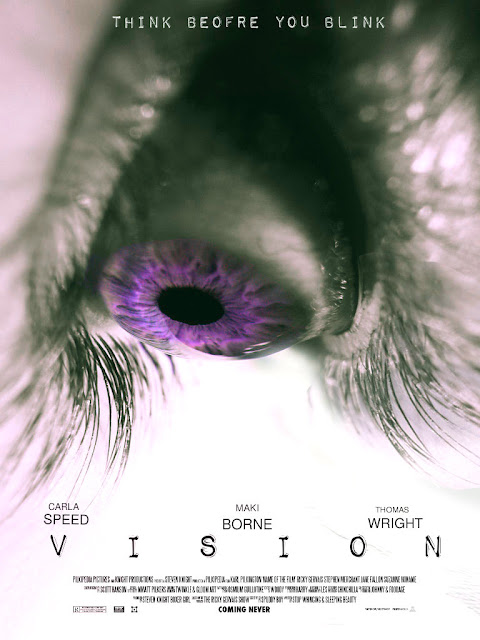
This is a preliminary poster that I have made in class, in which I looked at the conventions of a successful horror poster and have applied them to a 'faux' poster where we had to come up with a word and make a horror poster using that word as a prompt.  What I love about this poster is how simple it is, in which the main image is simply an unnaturally coloured eye, it goes with the title seeing as vision is associated with eyes. Also, the unnatural colour of the eye can be associated with the horror genre because of how surreal it looks and how the "unnatural" is a major trope to the genre. Furthermore, the colours are contrasting seeing as white is the lightest tone and purple is a fairly dark colour, by the two colours contrasting each other, the main focus will be towards the purple iris. However, white is not a conventional colour for a horror poster, whereas black is known to be the most used due to the connotations with the colour, in which black repres...

Film poster history

Image
Loading...

Reading horror films

Image
Media text, whether it is horror or romance, are open to multiple readings. Horror films are considered to be deliberately ambiguous in which the audience who watches them are more likely to misunderstand the whole plot (such as Babadook or The shining..)   Stuart Hall, a cultural theorist and a professor of sociology, looks at the role of audience in the interpretation of media texts by different social groups. Hall came up with a model suggesting 4 ways in which we may read a media text: Preferred/dominant: This is when the audience will prefer to read the text (in our case, a horror film), in the way the producer has intended them to. So that the meaning is clear, natural and transparent to do so. Oppositional: This is when there is a disagreement with the ideology/film from the genuine idea, so they reject the reading. Negotiated: This looks at how the audience would work out the meaning of the film with the concepts that they disagree with or they don't unde...

Auteur theory

Image
Doing some research, I have looked at some horror auteurs. One example, is John Carpenter, who is a populist film director who has been heavily influenced by 50s Sci-fi and horror films and is well known for his horror films such as the "Halloween" series and "The thing" (1982). What makes his films fall into the Auteur category: Entrapment: Characters or a group of characters are trapped either physically or metaphysically Carpenter's heroes: Defined by action and has an ideology that all people are defined by what they do Anti-authority: Carpenter's films disrupt authority. Likes to put humanity into perspective: There is more on Earth than we know Genre: Follows the syntactic /semantic approach to genre and will allow generic cross over A good example of Carpenter's film that supports him as an auteur is, "The thing": Looking at the Dogme 95' and the Vow of chastity, it has got me thinking about whether I should app...

Horror films: the economics

In regards to my film, I will be using a small budget. This is only because I'm barely a student, not just because I'm making a horror short. So, for me to work on a big budget film, is fairly close to impossible. But there are many softwares out there that I can use to make this film look like a big budget film and that's what I plan to do. If all works out to plan, that is. 

Uses and Gratification

Uses and gratification theory looks at why and how people seek out specific media/texts to satisfy specific needs. Uses and gratification is an audience-centered approach to understand what the audience wants in a certain piece of media and how to communicate with them through that piece. As for horror, we must look at what the audience want in horror films and why they watch it. This does connect with my " Why do people watch horror films " post seeing as we do look at the reasons behind it.  Dr. Goldstein: Goldstein suggests that people watch horror films because they want to be frightened, because otherwise they wouldn't keep going to them. People choose to watch these films because they want it to affect them, and in order to feel satisfied at the end there must be a resolution. Audiences can control how much or how little something will affect them, therefore some people may not be affected at all. Dr. Walters: There are many factors that make people want t...

Story and Narrative

Image
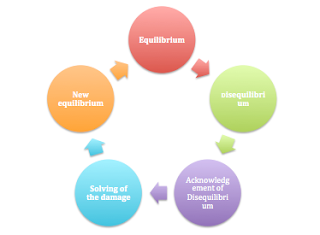
Story and narrative are surprisingly two different aspects of storymaking, whether it's in a book or through the media. One thing that we can establish, is that they are both important and are used to create an effect on the audience that is long lasting.  The story is the events that occur within the film or text. It will give the audience information about the setting, characters and what is happening in the film. The story is usually built up over time to captivate the audience into the film in the way the director/writer intended it to be. Whereas, the narrative is how the story is told. This is mainly looking at the structure of the story, the themes and how it is presented. There is a basic structure to how a story is narrated and this includes a beginning, middle and end, but there are other ways in which a story can be narrated. Todorov's narrative theory: Tzvetan Todorov has proposed a theory in which he looks at the conventional structure of the narrative...